
The Last Useful Generation
How a small group of billionaires, their political investments, and the party they purchased are engineering the end of human economic relevance — and what the rest of us can do about it.

This backgrounder is part of The Quiet Cost’s National Quiet Costs series, examining where responsibility shifts in federal policy, markets, and public systems. Prior backgrounders are available at The Quiet Cost.
Short on time? A plain language summary is available at the end of this piece.
A note on length: This backgrounder is substantial — six chapters and a plain language summary. Email clients may truncate it. The complete piece is available in full at The Quiet Cost. We recommend reading on the web.
Chapter One: What You Were Promised
He came down the escalator.
If you watched it live — or saw it replayed, as it was replayed thousands of times in the months and years that followed — you remember the feeling it produced in a specific kind of American household. Not the households of the comfortable. Not the households of the credentialed. The households where the work had changed, or disappeared, or been replaced by something that paid less and asked more and offered nothing resembling the security that the generation before had built and expected and, in many cases, watched slowly taken away.
In those households, something stirred.
Not because the man coming down the escalator was trustworthy — many of the people who felt that stirring had no particular illusion about his character. Not because his policies were coherent — most of what he said that day was not policy, it was mood. It was permission. Permission to be angry at the ‘right’ targets, finally, after decades of being told that the targets they instinctively identified — the corporations that had moved the jobs, the trade deals that had hollowed the towns, the political establishment of both parties that had managed the decline while calling it progress — were either imaginary or unavoidable or somehow their own fault for not adapting fast enough.
He said: you’ve been forgotten.
He said: the people who were supposed to represent you sold you out.
He said: I’m going to bring it back.
None of those three statements was entirely false. That is the thing worth sitting with before anything else in this backgrounder. The forgotten part was real. The selling out part was real — documented, in fact, in considerable detail in The Quiet Cost’s New Hampshire series, and visible in every former mill town and hollowed manufacturing community from Michigan to Maine. The anger was not manufactured. It was earned, over decades, by a system that had been doing exactly what the man on the escalator said it had been doing — just not for the reasons he implied, and certainly not with the solution he was offering.
The product was mislabeled.
Not entirely false on the outside. Genuine grievance, real anger, legitimate targets. But open the package and examine what was actually inside — the policy framework, the donor list, the regulatory agenda, the people placed in positions of power — and the contents bear no relationship to what the label promised.
What was promised to the working family in the hollowed-out manufacturing town:
The jobs coming back. Specifically, the manufacturing jobs — the ones with the union card and the pension and the healthcare and the dignity of making something with your hands that the world needed. The ones that had been leaving, slowly at first and then with gathering speed, for forty years.
The trade deals renegotiated. The corporations that had moved the work overseas brought to account. The executives who had chosen shareholder returns over American workers named and shamed and prevented from doing it again.
The establishment destroyed. The donors defied. The lobbyists sent home. A president who couldn’t be bought because he was already rich — who owed nothing to the people who had been buying politicians for decades and therefore would answer only to the people who voted for him.
The forgotten remembered. The left-behind lifted. The system that had been working against them finally, for the first time in most of their adult lives, working for them.
That was the promise. It was specific enough to feel real, emotional enough to feel urgent, and targeted accurately enough at genuine grievances that the people who needed most to believe it did believe it — not because they were foolish, but because they were desperate, and because the alternative on offer felt like more of the system that had already failed them.
Here is what the working family in that hollowed-out town actually received.
The man who came down the escalator surrounded himself, from the first days of his administration, with the precise category of people he had promised to destroy. Not the old establishment — that version was yesterday’s villain, already sufficiently discredited. The new version. The tech billionaires. The hedge fund managers. The cryptocurrency speculators. The artificial intelligence entrepreneurs whose stated goal — stated openly, in their own words, in their own publications and interviews and conference presentations — was to build a world that needed as few human workers as possible.
He didn’t drain the swamp. He restocked it — with a newer, more expensive, more technologically sophisticated species of exactly the kind of people whose decisions had been loading the cost of their ambitions onto working families for the past fifty years.
And the working families who had cheered the loudest at the escalator moment — the ones in the former mill towns, the ones whose fathers had punched the clock and whose children couldn’t find work that paid what the clock-punching once paid — those families are now watching their approval of the man they sent to fight for them collapse in real time.
By late March 2026, among Americans earning under $50,000 a year — the households living closest to the economic reality this backgrounder describes — Trump’s approval had fallen to 29 percent. Disapproval: 70 percent.
The product has been opened. The contents examined.
The label and the contents are not the same thing.
This backgrounder is about what is actually in the package — who put it there, why, what it will do to the people who bought it, and what the rest of us can do about it before the damage becomes permanent.

Chapter Two: What They Actually Bought
Let’s talk about the transaction.
Not the rhetoric surrounding it. Not the campaign promises or the rally energy or the carefully cultivated image of a billionaire who had somehow transcended his own class to become the champion of the people his class had spent decades extracting wealth from. The transaction itself. The money that moved. The access that followed. The policy outcomes that resulted. The receipts.
Because there are receipts.
In American politics, the relationship between political investment and policy return has rarely been as direct, as documented, and as openly acknowledged as it has been in the current administration. The donors did not hide. The access was not concealed. The regulatory outcomes were not subtle. What was remarkable — what distinguishes this moment from the ordinary corruption of ordinary political influence — was the scale, the speed, and the sheer brazenness of the exchange.
The working family that voted for the man on the escalator because he promised to fight the donor class should know what the donor class actually purchased. It is all public record.
Elon Musk.
By the most widely reported accounting, Elon Musk contributed approximately $250 million to support Donald Trump’s 2024 campaign and related political efforts — the largest individual political contribution in American history. What followed was not subtle.
Musk was given co-leadership of the Department of Government Efficiency — DOGE — an entity with no statutory authority, no congressional authorization, no Inspector General, and no meaningful oversight, which proceeded to dismantle federal agencies, fire career civil servants, and access sensitive government data systems at a scale and speed that career officials described as without precedent. The specific agencies targeted — the Consumer Financial Protection Bureau, the Federal Trade Commission, the Securities and Exchange Commission’s enforcement division — were, with remarkable consistency, the agencies whose regulatory mandates most directly constrained the business activities of Elon Musk’s companies.
Tesla faces consumer protection and safety investigations. SpaceX holds federal contracts and operates under FAA oversight. X — formerly Twitter — operates in a regulatory environment shaped by FTC and SEC decisions. Neuralink operates under FDA jurisdiction. The Boring Company operates under local and federal permitting authorities.
Every one of those regulatory relationships became more favorable to Musk’s interests in the months following his $250 million investment.
This is not alleged. It is documented in federal agency records, congressional testimony, and the reporting of outlets across the political spectrum including the Wall Street Journal, Reuters, and the Associated Press.
What is documented goes further still. DOGE personnel accessed Treasury payment systems, Social Security Administration databases, and the Office of Personnel Management records covering millions of federal employees — in many cases over the explicit objections of career officials and in apparent violation of existing privacy and security protocols. Federal judges issued temporary restraining orders against some of this access. The Government Accountability Office opened investigations. Career officials filed whistleblower complaints.
What remains an open and formally unresolved question — raised in those whistleblower complaints and in congressional testimony by career intelligence and cybersecurity officials — is whether the access was structured to be temporary or permanent. Whether the doors opened during DOGE’s tenure were closed when DOGE’s public role receded, or whether they remain open. That question has not been answered. The people with the authority to answer it have not been asked under oath.
Jared Kushner.
While serving as a senior White House advisor during Trump’s first term, the President’s son-in-law, Jared Kushner, oversaw Middle East policy — including relationships with Saudi Arabia’s Crown Prince Mohammed bin Salman. Six months after leaving the White House in January 2021, Kushner’s newly formed private equity firm, Affinity Partners, received a $2 billion commitment from the Saudi Public Investment Fund — the sovereign wealth fund controlled by the Crown Prince whose relationship Kushner had cultivated in his official government capacity.
The Saudi investment committee’s own advisors reportedly recommended against the investment on standard financial grounds. The committee overruled them.
Affinity Partners has since invested heavily in technology infrastructure, artificial intelligence, and the specific sectors being accelerated by the administration’s deregulatory agenda. In 2026, Kushner emerged as a central figure in negotiations surrounding the Iran conflict — despite holding no official government position, no formal diplomatic credentials, and no qualification for the role beyond the personal relationships he cultivated while serving in his father-in-law’s first administration. He has stated publicly his ambition to grow Affinity Partners to $5 billion in assets under management. The Saudi sovereign wealth fund that seeded that firm with $2 billion has direct and substantial interests in the outcome of any Middle East settlement. The man helping to shape that settlement is financially connected to one of its most interested parties. This is not alleged. It is the documented structure of the arrangement.
Peter Thiel, Marc Andreessen, David Sacks.
Peter Thiel — PayPal co-founder, Palantir chairman, early Facebook investor — was an early and significant Trump supporter who helped shape the administration’s technology and national security posture in the first term. His protégé JD Vance is the Vice President of the United States.
Marc Andreessen and Ben Horowitz — whose venture capital firm Andreessen Horowitz manages approximately $35 billion in assets with heavy concentration in artificial intelligence, cryptocurrency, and technology infrastructure — publicly endorsed Trump in June 2024 after years of Democratic alignment, citing specifically the regulatory environment for cryptocurrency and AI. The administration’s approach to both has been precisely what they requested.
David Sacks — venture capitalist, former PayPal executive, podcast host — was appointed the administration’s AI and Crypto Czar, a position created specifically for him, with a mandate to shape the regulatory environment for the two asset classes in which his portfolio is most concentrated.
These are not people who wandered into the administration from outside the donor class. They are the donor class — the specific, named, documented individuals whose financial interests are most directly served by the deregulatory agenda being implemented, placed in or adjacent to the positions implementing it.
The Project 2025 connection.
Project 2025 — the 900-page policy document prepared by the Heritage Foundation and approximately 80 allied organizations in the years before the 2024 election — is not a conspiracy theory. It is a published document, available in its entirety, whose recommendations have been implemented with remarkable fidelity in the current administration’s executive orders, regulatory rollbacks, and agency restructurings.
The document’s approach to labor regulation, environmental oversight, consumer protection, and technology governance is consistent throughout: reduce the regulatory burden on corporations, eliminate the agencies whose mandate is to constrain corporate behavior, and remove the legal protections that give working people leverage in their relationship with employers.
It is, in policy document form, the completion of the fifty-year project that The Quiet Cost’s New Hampshire series documented at state level — the systematic dismantling of the structural protections that stand between working families and the full consequences of unregulated corporate power.
The man on the escalator said he had never read it and didn’t know what it was. His administration has implemented it with the thoroughness of someone who had memorized it.
What the working family received.
The manufacturing jobs did not come back. United States manufacturing employment has not recovered to the levels of the 1970s and 1980s — nor was it ever going to, regardless of tariff policy, because the jobs that left did not leave primarily because of trade deals. They left because of automation. They are not coming back because the automation that replaced them is being accelerated, funded, deregulated, and politically protected by the precise people who were given access to the levers of government in exchange for $250 million and the contents of a venture capital portfolio.
The trade deals were renegotiated — and then renegotiated again, and then partially reversed, and then threatened again, in a cycle of tariff announcements and walk-backs that produced the one outcome guaranteed to harm working families most directly: uncertainty. Businesses do not invest in domestic manufacturing under conditions of policy uncertainty. They wait. The workers who were supposed to benefit from the reshoring that was supposed to follow the tariffs are still waiting.
The establishment was not destroyed. It was replaced — with a newer, more expensive, more technologically sophisticated establishment whose financial interests are more concentrated, whose accountability is less visible, and whose policy agenda is more directly and completely hostile to the economic participation of working people than the establishment it displaced.
The forgotten were not remembered. They were useful — for one election cycle — and are now being processed as a constituency to be managed rather than a population to be served.
The receipts tell the story that the rally energy was designed to prevent anyone from reading.
Chapter Three: The Machine That Doesn’t Need You
Let’s start with a number.
Since the year 2000, United States manufacturing output — the total value of goods produced by American factories — has increased by approximately 40 percent. In that same period, the number of Americans employed in manufacturing has fallen by approximately 4.5 million jobs.
Read that again.
More stuff being made. Fewer humans making it. The productivity didn’t go to the workers whose labor and expertise built the industrial base that made the expansion possible. It went to the shareholders. To the quarterly report. To the board of directors that does not know your name and has no particular interest in whether you have a pension or a healthcare plan or a town worth living in.
This is not a trade story. This is an automation story. And it is the most important economic story of the past quarter century — told almost nowhere in plain language, to the people it is happening to, in time for them to do anything about it.
The manufacturing jobs that left did not leave primarily because of trade deals. Some did — the China shock following Beijing’s entry into the World Trade Organization in 2001 was real and devastating for specific communities, as The Quiet Cost documented in the story of Berlin, New Hampshire on September 10, 2001. But the deeper, more durable, more consequential force was not a trade agreement. It was a machine.
Specifically: it was the decision, made by the boards of directors who did not know your father’s name, to replace human labor with automated systems wherever the math made it profitable to do so — and then, crucially, to keep the productivity gains rather than share them with the workers whose displacement made those gains possible.
That decision was made in corporate boardrooms. It was enabled by a policy environment that provided no meaningful disincentive to make it and no meaningful support for the communities it devastated. It was accelerated by a political system — of both parties, as The Quiet Cost has been careful to document — that prioritized the interests of the shareholders over the interests of the workers. And it is now being completed, at a speed and scale that prior waves of automation never approached, by a technology that does not merely replace physical labor.
It replaces thinking.
The AI acceleration.
Every prior wave of automation in American history displaced a specific category of human work while leaving others intact or even expanded. The mechanical loom displaced hand weavers but created factory jobs. The assembly line displaced craftsmen but created assembly workers. The computer displaced certain clerical functions but created technology jobs. Each wave produced disruption and each wave produced, eventually, new categories of work that absorbed some of the displaced.
The current wave is different in a way that is not yet fully understood by the people it is happening to — partly because it is moving faster than any prior wave, and partly because it is happening to categories of work that their holders believed were automation-proof.
Artificial intelligence is not displacing factory workers. It is displacing radiologists, lawyers, accountants, financial analysts, customer service representatives, writers, coders, graphic designers, paralegals, and the entire category of knowledge workers whose credentials and expertise were supposed to be the safe harbor in a world where physical labor was becoming automated. The service sector jobs that were supposed to absorb the manufacturing displacement are themselves being automated — simultaneously, in the same decade, before the prior displacement has been addressed.
The tech billionaires who funded the political apparatus described in Chapter Two are, in their own publications and conference presentations and investor letters, entirely candid about what they are building and what it means for human employment. This is not their dirty secret. It is their stated goal.
Sam Altman — CEO of OpenAI, one of the most consequential artificial intelligence companies in the world — has written publicly about a future in which AI systems handle most of the cognitive work currently performed by humans, and in which the question of what humans do economically in that world remains, in his own framing, unresolved.
Marc Andreessen — whose firm’s endorsement of Trump was cited in Chapter Two — has written extensively about what he calls the “techno-optimist” vision: a future in which technology eliminates scarcity, including the scarcity of human cognitive labor. He has described concerns about AI displacement as “a moral panic” and argued that the correct response to automation is to accelerate it.
Peter Thiel has written and spoken at length about his belief that democratic politics and technological capitalism are fundamentally incompatible — that the future belongs to those who understand that the constraints democratic societies place on capital and technology are obstacles to progress rather than protections for people.
These are not fringe views held in secret. They are the published, documented, openly stated philosophical commitments of the people who provided the financial foundation for the political apparatus now dismantling the regulatory framework that stood between working Americans and the full consequences of those commitments.
They funded the deregulation. They are building the machines. They have told us, in their own words, what the machines are for.
What the machine produces.
A warehouse that employed 500 people in 2015 employs 50 in 2025 — and the 50 are there to maintain the robots, until the robots can maintain themselves. A customer service center that employed 300 people in 2018 employs 12 in 2026 — and the 12 are there to handle the calls the AI cannot yet manage, until it can. A legal firm that employed 40 paralegals in 2020 employs 8 in 2026 — and the 8 are reviewing the documents the AI produced, until the AI can review them itself.
The machine is not finished. It is accelerating.
Consider what happened to the taxi medallion.
At their peak, New York City taxi medallions — the licenses required to operate a yellow cab — sold for over $1 million each. Drivers, many of them immigrants who had saved for years and borrowed from family, bought them as retirement investments. The foundation of a life’s work. A tangible asset that represented decades of labor converted into something that could be passed to children or cashed out in old age.
Then Uber and Lyft arrived — backed by venture capital that deliberately absorbed years of losses to undercut the regulated market, deploying technology subsidized by investor money until the competition was destroyed. The medallion that sold for $1 million became worth $80,000. Drivers who had mortgaged everything watched their life’s investment collapse in real time. Several died by suicide. The wealth did not evaporate. It transferred — from the drivers who had earned it to the shareholders of the platforms that replaced them.
That transfer was not an accident of the market. It was a documented business strategy, funded by the same class of investor whose political investments are described in Chapter Two, enabled by a regulatory environment that allowed the new platforms to operate outside the rules the medallion system was built around.
And here is the part the Uber and Lyft story leaves out: the drivers who replaced the medallion taxi drivers were never the destination. They were the placeholder. The gig economy that was sold to them as flexibility and opportunity was, from the investor’s perspective, always a transitional workforce — humans filling seats until the technology was ready to eliminate the need for humans in seats entirely. Waymo, Tesla, Uber’s own autonomous vehicle program — the self-driving taxi is not a future projection. It is a current deployment, expanding city by city, quarter by quarter, toward the moment when the gig driver discovers that the platform that displaced the medallion driver has now displaced them.
The highway tells the same story at larger scale.
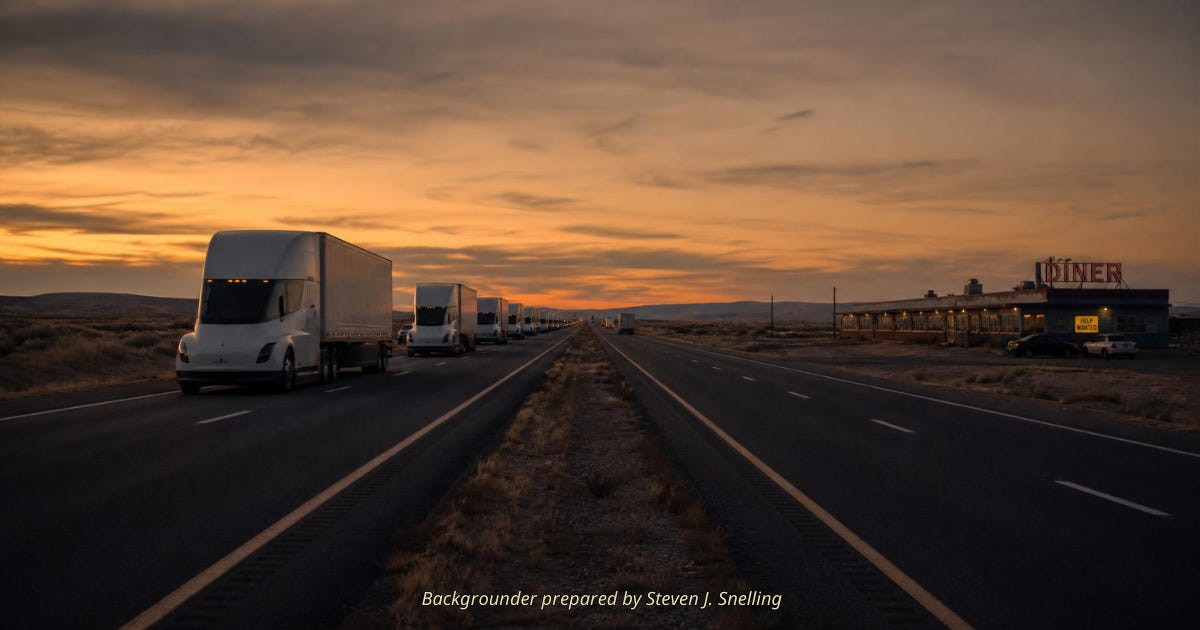
There are approximately 3.5 million truck drivers in the United States. Long-haul trucking is the most common occupation in 29 states. The people behind the wheels of the tractor-trailers moving every product that every American buys — the food, the medicine, the appliances, the construction materials — are, by any honest accounting, the circulatory system of the physical economy. They are also, by the explicit stated plans of the companies building autonomous vehicle technology and the investors funding those companies, scheduled for replacement.
The autonomous truck is not science fiction. Waymo Via, Aurora, Kodiak Robotics, and others are actively deploying self-driving freight vehicles on American highways. The technology is not yet fully mature. It will be. The question is not whether the 3.5 million drivers will be displaced. The question is how quickly, and what happens to them and their families and their communities when they are.
And here is the piece that the people selling this transition consistently leave out of their presentations to investors: the productivity gains from this automation are not being distributed to the workers being displaced. They are not being taxed and redistributed through public systems that might cushion the transition. They are not being invested in the retraining programs that might prepare displaced workers for whatever comes next. They are being captured — by the shareholders, by the quarterly report, by the board of directors, by the tech billionaires whose net worth has increased by trillions of dollars in the years during which the displacement has accelerated.
The machine produces output. The output produces profit. The profit goes to the people who own the machine. The people who used to do the work the machine now does are invited to find other work — in a labor market that is also being automated, in communities that lost their tax base when the factory closed, in a policy environment that has been systematically stripped of the safety net that might have made the transition survivable.
This is not the natural order of things. It is a policy choice. It is the choice to allow — and in the current administration’s case, to actively accelerate and politically protect — the capture of automation’s productivity gains by the people who already have the most, while distributing its displacement costs to the people who have the least.
The service sector trap.
For decades, the standard answer to manufacturing displacement was: the service sector will absorb it. People will always need haircuts, restaurant meals, healthcare, retail, hospitality. These jobs cannot be automated. They require human presence and human judgment and human interaction. The service sector will be there.
That answer was always partial — service sector jobs pay less, offer fewer benefits, provide less stability, and carry none of the union protections that made manufacturing jobs the foundation of the middle class. But it was at least an answer. A place to go. A category of work that the displaced could enter.
Artificial intelligence is now automating the service sector.
Not the haircuts — not yet. But the scheduling, the intake, the diagnosis, the prescription, the customer interaction, the financial advice, the legal guidance, the educational instruction, the creative work, the analytical work — the cognitive layer that sat above the physical service and provided the higher-paying jobs in the sector. That layer is being automated faster than the manufacturing layer was, because cognitive work is more amenable to software than physical work is to robotics.
The working family that lost the manufacturing job and retrained for a service sector career — that spent money and time acquiring the credential that was supposed to be automation-proof — is now discovering that the credential is not automation-proof. The automation just took longer to arrive than it did in the factory.
The nirvana the tech bros are building.
It is worth being direct about what the people funding and building and politically protecting this transition actually envision as the endpoint.
Not a world in which automation frees humans from drudgery while preserving their economic participation and dignity. That is the public-facing version of the argument — the one that gets presented at TED talks and in op-eds designed for general audiences.
The private-facing version — the one that appears in investor letters and conference presentations and the philosophical writings of the movement’s intellectual leaders — describes something considerably different. A world in which a small number of humans own and operate the systems that produce essentially all economic value. In which the vast majority of humans are, in the precise economic sense, unnecessary to the production process. In which what those unnecessary humans do — how they survive, what meaning they find, what claim they have on the output of the systems that displaced them — is, at best, an unresolved question and, at worst, someone else’s problem.
Elon Musk has spoken publicly about universal basic income as a potential response to automation displacement — not as a commitment, but as an acknowledgment that the displacement is coming and that something will have to be done about the humans left behind. The something he envisions is a government check. Not a job. Not dignity. Not participation. A check. Enough to survive on. Sufficient to prevent the kind of social instability that might threaten the system producing the displacement.
A service sector. Ready and willing — due to the necessity of needing money to survive — to do things for the corporations and the wealthy. To be summoned when needed and dismissed when not. To exist at the pleasure of the machine and the people who own it.
That is not a dystopian projection. It is the logical endpoint of the documented trajectory — stated, in various forms, by the people building it, funded by the people profiting from it, and politically protected by the administration they purchased.
The working family on the former manufacturing floor — the one whose father punched the clock and whose pension is shrinking and whose children cannot find work that pays what the clock-punching once paid — is not a casualty of an inevitable technological future.
They are the intended residue of a specific set of choices made by specific people for specific reasons.
The machine doesn’t need them. That was always the point.

Chapter Four: The Architecture of Permanence
What separates this moment from prior moments of concentrated wealth and corporate power in American history is not the ambition. The Gilded Age had ambition. The railroad barons and the oil monopolists and the steel kings of the late nineteenth century had ambition that makes most modern billionaires look modest by comparison.
What separates this moment is the architecture.
The Gilded Age produced a backlash — the Progressive Era, the trust-busters, the labor movement, the regulatory framework that Theodore Roosevelt and later Franklin Roosevelt built specifically to prevent the concentration of economic and political power from becoming permanent. The system had excess. The excess produced reaction. The reaction produced correction.
That correction mechanism is being systematically dismantled. Not in one dramatic moment. Not with a single piece of legislation or a single court decision. In the same incremental, distributed, individually unremarkable way that The Quiet Cost documented in New Hampshire — except operating simultaneously at every level of the American legal and political system, with the full resources of the most concentrated wealth in human history behind it.
The architecture of permanence has five pillars. They were not built overnight. They have been under construction for decades. But in the current administration, for the first time, all five are being assembled simultaneously, with deliberate coordination, toward a specific and documented endpoint.
Pillar One: Money as Speech.
In 2010, the United States Supreme Court decided Citizens United v. Federal Election Commission. The decision held, five to four, that the First Amendment prohibits the government from restricting independent political expenditures by corporations, associations, and other legal entities — including, effectively, the billionaires whose investment vehicles are structured as such entities.
The practical consequence was the removal of the most significant legal constraint on the translation of concentrated wealth into political power. Before Citizens United, there were limits. Imperfect limits, frequently circumvented, but limits — legal acknowledgment that the relationship between money and political outcomes required at least nominal regulation in a democratic system.
After Citizens United, the limits effectively disappeared. The $250 million that Elon Musk contributed to the 2024 Trump effort was legal. The hundreds of millions that flowed from Silicon Valley venture capitalists into the political apparatus that would deregulate their industries was legal. The entire documented transaction described in Chapter Two was legal — because the Supreme Court said that money is speech, and speech cannot be restricted, and therefore the wealthiest humans in the history of the world can purchase as much political speech as their wealth allows.
The working family that voted in the same election contributed, on average, nothing to any campaign. Their speech — in the only form the post-Citizens United system recognizes as consequential — was worth exactly what they could afford to spend on it.
The court that produced this outcome was not a neutral arbiter. It was a court whose majority was shaped by a decades-long, coordinated, heavily funded effort — led by the Federalist Society, funded by the same donor class that benefits from the outcomes — to place specific kinds of justices in specific seats at specific moments. Chief Justice John Roberts, who wrote the majority opinion in Citizens United, began his career as an attorney in the Reagan administration — in the same era when the intellectual and legal foundations of what would become Project 2025 were being developed by the same Federalist Society network that shaped his judicial philosophy. The architecture was patient. It took thirty years. It worked.
Pillar Two: Corporate Personhood.
Citizens United rested on a legal foundation that had been under construction since the nineteenth century and was dramatically expanded in the decades preceding the decision: the doctrine of corporate personhood — the legal treatment of corporations as persons entitled to constitutional protections.
Mitt Romney, at a 2011 campaign event, said what the legal establishment had long treated as a technical truth: “Corporations are people, my friend.” He was mocked. He was also correct — as a description of what the law had become, if not as a description of what it should be.
A corporation is a legal fiction created by the state to limit the liability of its human shareholders. It was designed as a tool — a mechanism for organizing capital and distributing risk. It was not designed as a person. It has no body that can be imprisoned. It has no family that can be harmed. It has no community that it is rooted in and responsible to. It exists on paper, in the interests of its shareholders, for as long as it is profitable to exist.
The Supreme Court has, over decades of incremental decisions, granted this legal fiction an expanding portfolio of constitutional rights — speech rights, religious rights, due process rights — while the human beings who work for and are affected by corporations have seen their practical ability to exercise those same rights eroded by the same legal and political system.
The corporation that employs the former mill worker has constitutional speech rights that the former mill worker’s union does not. It has religious liberty claims that can override its employees’ healthcare decisions. It has due process protections that insulate it from regulatory accountability in ways that the individual worker facing a wage theft claim cannot access.
This is not a description of a system that treats persons equally before the law. It is a description of a system that has created a hierarchy of persons — in which the legal fiction sits above the human being, and the human being’s economic participation, dignity, and security are subordinate to the quarterly report of the entity that employs them.
Pillar Three: The Shadow Docket.
The Supreme Court of the United States has, in recent years, dramatically expanded its use of what legal scholars call the shadow docket — emergency orders and unsigned decisions issued without full briefing, without oral argument, and without the named, reasoned opinions that allow the public to understand who decided what, and why, and on what legal basis.
The shadow docket is not new. Emergency orders have always existed. What is new is the scale, the consequential nature of the decisions being made through it, and the explicit use of unsigned orders to advance policy outcomes that named, argued, majority opinions could not survive public scrutiny.
In the current term alone, the shadow docket has been used to allow the administration to proceed with mass deportations while legal challenges were pending, to reinstate federal employees fired in apparent violation of civil service law and then fire them again, to permit the dismantling of federal agencies whose statutory existence has not been challenged through normal legislative channels, and to advance elements of the Project 2025 agenda that have not been subjected to the democratic deliberation that normally precedes major policy change.
The people most directly harmed by these orders — the deported, the fired, the communities whose environmental and labor protections have been removed — have no named justice to hold accountable. No authored opinion to challenge. No reasoning to rebut. The decision arrives unsigned, unexplained, and largely unreported outside the legal press, because a Supreme Court order without a named author and a reasoned opinion is not the kind of story that cable news covers for three days.
It is the judicial version of the incremental transfer documented throughout this series. Consequential decisions made without accountability, distributed across enough individual orders that no single one generates the sustained opposition that a landmark named decision would produce.
Chief Justice John Roberts has expressed concern about the shadow docket’s expansion. His concern has not slowed it.
The architecture doesn’t require unanimous enthusiasm. It requires enough votes, consistently applied, in the direction the funders require.
Pillar Four: Project 2025 as Operating Manual.
The Heritage Foundation’s Project 2025 — formally titled “Mandate for Leadership: The Conservative Promise” — is a 900-page policy document prepared by approximately 80 conservative organizations in the years before the 2024 election. It is not a wish list. It is an implementation manual — written by people who expected to be in government, for people who would be in government, describing in operational detail how to use the first 180 days of a new administration to make changes that would be difficult or impossible to reverse.
The document has been implemented with a fidelity that its authors did not entirely anticipate. Executive orders, agency restructurings, personnel decisions, regulatory rollbacks — the correspondence between Project 2025’s specific recommendations and the administration’s specific actions has been documented by journalists, legal scholars, and congressional researchers across the political spectrum.
The relevant sections for this backgrounder are not the culture war provisions — those have received the most public attention and generated the most opposition. The relevant sections are the ones that received the least attention: the labor regulation rollbacks, the consumer protection dismantlings, the environmental regulatory eliminations, the technology governance frameworks, and the specific restructuring of the agencies whose mandate is to constrain the behavior of the corporations whose representatives wrote the document.
The people who wrote the labor sections of Project 2025 represent industries that employ workers. The people who wrote the technology governance sections represent industries that are automating those workers. The people who wrote the consumer protection sections represent industries that sell to those workers. In each case, the document recommends reducing the regulatory burden on the industry and reducing the protection available to the worker, the consumer, and the community.
It is, in policy document form, the completion of the fifty-year project — the same direction of travel documented in The Quiet Cost’s New Hampshire series, applied simultaneously to every regulatory domain at federal scale.
The autonomous vehicle provides one of the clearest illustrations of how Project 2025’s labor agenda and the tech billionaire agenda of Chapter Two converge into a single documented outcome. The Teamsters — one of the most powerful unions remaining in American labor, representing a significant portion of the 3.5 million truck drivers whose livelihoods depend on human beings being necessary behind the wheel — endorsed neither major party candidate in 2024, a historic break from their traditional Democratic alignment, citing economic concerns that the man on the escalator had been loudly amplifying. Project 2025 explicitly targets union power through regulatory rollback and labor law restructuring. The autonomous vehicle technology being deregulated and accelerated by the administration that received $250 million from the man most publicly associated with its deployment is the mechanism that will accomplish what fifty years of direct anti-union legislation could not: the elimination of the Teamsters’ membership base, their dues revenue, their political power, and their ability to serve as a check on the transportation and logistics industry’s treatment of its workforce. This is not a side effect of technological progress. It is a convergence of financial interest, policy agenda, and political investment — documented, specific, and moving forward at highway speed.
Pillar Five: The Tilted Table.
Everything described in the first four pillars assumes that democratic elections remain a functional corrective mechanism — that if enough people understand what has been done and vote accordingly, the architecture can be dismantled by the same democratic process that allowed it to be built.
That assumption is being addressed.
Not through a single dramatic act of election cancellation or suspension — nothing so visible or so easily opposed. Through the same incremental, distributed, individually defensible method that has characterized every other element of the architecture. Each action framed as protecting election integrity. Each action producing, in documented practice, the opposite.
In September 2025, the Department of Justice sued several states for refusing to share voter registration lists with the federal government — lists that include driver’s license and Social Security numbers historically closely guarded by state election officials. Countersuits allege the administration is unlawfully using the data to suppress voters. A South Carolina judge who temporarily blocked the administration’s data request received death threats after being criticized by a Trump official. Her house subsequently burned down.
In April 2026, a federal appeals court found that DOGE personnel within the Social Security Administration had signed an unauthorized agreement to turn over state voter rolls to a political advocacy group. The same DOGE whose access to government data systems raised the back door concerns documented earlier in this backgrounder was, separately and simultaneously, moving voter data to a private political organization.
Project 2025 devised a plan for the incoming administration to prosecute those who help people vote — specifically suggesting prosecution of the Pennsylvania secretary of state for the state’s use of provisional ballots. A July 2025 survey from the Brennan Center for Justice found that nearly half of the election workers polled were concerned about politically motivated investigations of election officials. Fifty-nine percent worried that political leaders would interfere with their jobs.
The administration has sent a clear message about future elections: those who resist election subversion will face consequences. Those who participate in election subversion will have the administration’s support. The January 6th participants were pardoned. Some were awarded. Some were placed in prominent positions in the current administration. The message has been received by the people it was intended for.
Democracy Docket obtained and published a draft executive order, dated April 12, 2025, that would authorize the president to declare a national emergency and assume direct federal control over election administration. Legal scholars described the proposed order as blatantly unconstitutional — but its circulation, and the administration’s demonstrated willingness to issue executive orders that courts must then scramble to enjoin, represents a standing threat whose shadow falls over every aspect of 2026 election planning.
The Voting Rights Lab’s CEO Samantha Tarazi stated plainly: “These efforts make it clear President Trump is preparing to use the power of his office to interfere in the 2026 election. What started as an unconstitutional executive order has now grown into a full federal mobilisation to seize power over our elections.”
The midterm elections of November 2026 — in which all 435 House seats and 35 Senate seats are contested — represent the most direct available democratic check on everything this backgrounder has documented. The loss of Republican majorities would hand oversight power to their opposition and expose the administration’s actions to the congressional scrutiny they have so far avoided.
The administration knows this. The actions described above are not separate from the policy agenda of Chapters Two, Three, and Four. They are its protection mechanism. The architecture of economic concentration documented in this backgrounder cannot survive a genuinely free and fair election in which the people bearing its costs understand what is being done to them and by whom.
Which is precisely why the election is being addressed.
A January 2026 survey by the University of California San Diego’s Center for Transparent and Trusted Elections, conducted among 11,406 eligible voters, found that confidence in elections has dropped by 17 percentage points since the 2024 presidential election.
That 17-point drop in electoral confidence is not a side effect of the actions described above. It is their purpose. A population that does not believe its vote counts is a population that does not vote. A population that does not vote cannot correct what has been built.
The table is being tilted. The tilt is documented. The people doing the tilting are named.
The architecture assembled.
Money as speech removes the constraint on political purchase. Corporate personhood elevates the legal fiction above the human being. The shadow docket advances the agenda without accountability. Project 2025 provides the implementation manual. The tilted table ensures that the democratic correction mechanism is compromised before it can be used.
Together they describe not a series of independent legal and political developments but a coherent system — assembled over decades, accelerated in the current moment, designed to make the concentration of economic and political power in the hands of the people described in Chapter Two as permanent and as legally protected as the existing constitutional order will allow.
The Gilded Age barons did not have this architecture. They had money and they had politicians. They did not have a Supreme Court majority shaped by thirty years of coordinated judicial appointments, a policy implementation manual written in advance of taking power, a legal doctrine that treated their corporations as persons with constitutional rights, a technology that could replace the workers whose collective action had historically been the most reliable check on concentrated economic power, and a documented campaign to compromise the elections that might otherwise correct the course.
The working family on the former manufacturing floor is not facing a billionaire with money and a politician.
They are facing an architecture.
And the architecture was built specifically so that the tools they would normally use to fight back — the vote, the union, the regulatory agency, the court — are either captured, constrained, or being systematically dismantled.
Knowing that is not the same as being defeated by it.
But it is the necessary beginning of understanding what actually needs to be done.
Chapter Five: The People Who Voted For It
Picture a specific person.
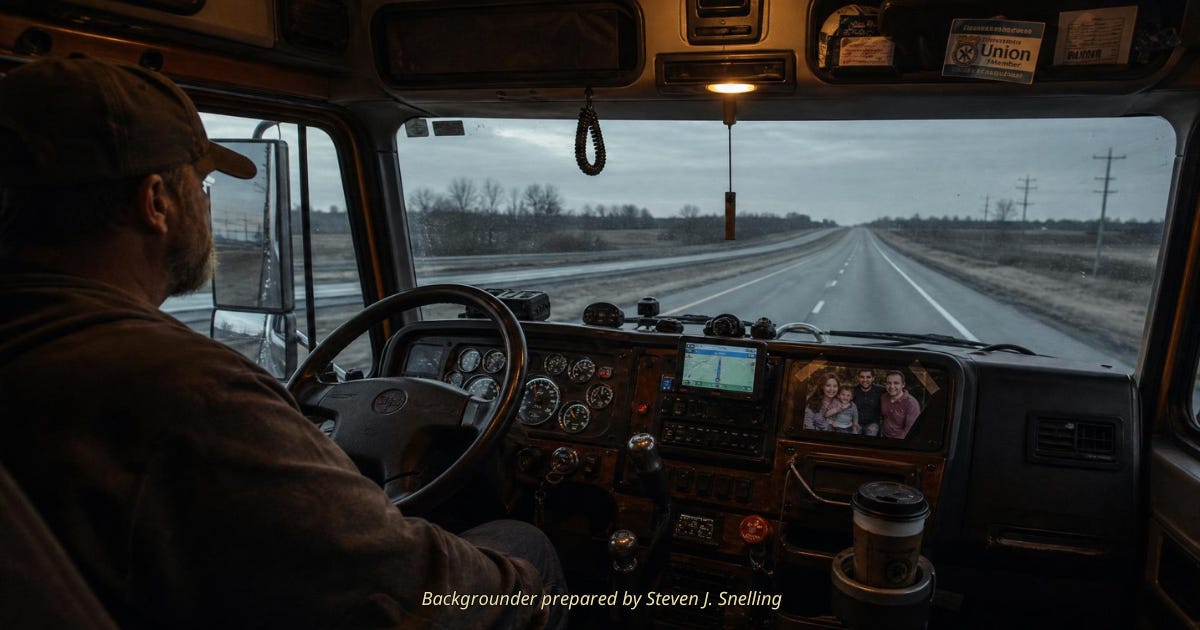
He is fifty-three years old. He has been driving long-haul for twenty-six years — the kind of work that takes you away from home for weeks at a time, that puts miles on your body as surely as it puts them on the truck, that requires a specific and underappreciated expertise: the management of forty tons of machinery across thousands of miles of changing weather, traffic, regulation, and road condition. He is good at it. He has been good at it for a long time.
He is a Teamster. His union card is not an abstraction to him — it is the mechanism that turned his labor into something negotiable, that produced the healthcare his family depends on and the pension that was supposed to mean something when the miles finally caught up with his knees and his back. He has paid his dues for twenty-six years. He has voted in union elections. He has walked a picket line once, in 2003, and he would do it again.
In November 2024, he voted for Donald Trump.
Not because he abandoned his union. Not because he stopped believing that workers deserve a fair share of what they produce. But because the man on the escalator said the things that nobody had said to him in a long time — that he had been forgotten, that the people who were supposed to represent him had sold him out, that the jobs and the dignity and the economic security that his father’s generation had built were worth fighting for and that someone was finally willing to fight.
He was not wrong to want those things. He was wrong about who was offering them.
My friend William has driven tractor-trailers professionally for decades. He has driven every major highway in this country — in every weather, in every season, with cargo that other people’s livelihoods depended on arriving safely and on time. He has forgotten more about the physics of forty tons in motion, the management of fatigue across a long haul, the judgment calls that keep other people’s families safe on the same roads, than most people will ever learn.
William told me about what has been happening to his profession from the inside. About the “driver shortage” narrative — manufactured and sustained by industry interests to justify lowering the entry standards that professionals like him spent careers meeting. About cheaper, less trained drivers flooding the market, suppressing wages, eroding the culture of professionalism that made the career worth having. About the steady devaluation of genuine expertise in service of a cost reduction that benefited the carriers and the shareholders and nobody behind any wheel.
The Owner-Operator Independent Drivers Association confirmed what William described. Their own statement put it plainly: “The decades-old ‘driver shortage’ narrative has been used to justify lowering standards and bringing inadequately trained drivers into the industry. The result has been a steady erosion of professionalism that has made our highways less safe.”
What William may not yet have seen assembled in one place is what the research for this backgrounder reveals: the lowering of standards and the development of autonomous vehicle technology are not separate stories. They are sequential chapters of the same story. The “shortage” narrative suppressed wages and weakened the union’s position. The cheaper workforce that replaced the professional standard is itself the placeholder — humans filling seats at reduced cost until the autonomous truck is ready to eliminate the need for humans in seats entirely. The FMCSA is targeting May 2026 — this month — for a proposed rule establishing the regulatory framework for autonomous truck deployment. The administration overseeing that rule received its political investment from the people building the trucks.
William’s expertise is being squeezed from both ends simultaneously. The entry bar lowered to flood the market with cheaper competition. The exit ramp being constructed in the form of autonomous vehicle regulation. The professional in the middle — with his union card and his decades of accumulated judgment and his pride in a difficult craft done well — is being treated not as a skilled worker whose contribution deserves protection, but as a transitional cost center on the way to a driverless fleet.
He is not alone. He is a data point — one of 3.5 million — in the most consequential labor displacement story in American history. And the people engineering that displacement funded the political apparatus that is supposed to be fighting for him.
The leaving has begun.
The numbers in this section are not from one pollster. They are not from one survey conducted on one day. They are from Pew Research, CNN, NBC News, Fox News, NPR, Emerson, and Leger — conducted independently, using different methodologies, across different time periods, arriving at the same documented conclusion.
The people who voted for the man on the escalator are leaving. Not all of them. Not the tribal loyalists for whom the identity of the movement has become more important than its outcomes. But the persuadable — the working class voters who voted on economic grievance rather than cultural allegiance — are opening the package and reading the contents label, and the contents do not match the label.
Among Americans earning under $50,000 a year — the households living closest to the economic reality this backgrounder describes — Trump’s approval fell from 38 percent in January 2026 to 29 percent by late March 2026. Disapproval: 70 percent. That is not a polling blip. That is a verdict.
Among working-class white voters — the demographic most associated with the MAGA coalition’s electoral foundation — approval flipped from a net positive of 9 points in July 2025 to net negative one point by late March 2026. The core constituency is cracking.
Among Hispanic Trump voters — people who voted for him specifically on economic grounds, on the promise that the man on the escalator understood their financial reality better than the establishment that had ignored it — approval has declined 27 points since early 2025. Twenty-seven points. In fourteen months.
In December 2025, a majority of Republicans identified as MAGA. By the spring of 2026, Republicans were evenly split between MAGA identity and traditional Republican identity. The movement’s hold on its own party is loosening — not because people are becoming Democrats, but because the gap between the promise and the delivery has become too wide to sustain with rally energy alone.
Big Data Poll director Rich Baris, whose firm has tracked this shift across multiple surveys, described the mood plainly: voters had “clearly run out of patience with the administration and his party” after months of warning signs and political grace.
The truck driver in the opening of this chapter is not a rhetorical device. He is a data point — one of millions — in a documented shift that is happening right now, in real time, among the precise population that this backgrounder is most urgently addressed to.
What the leaving looks like — and what it requires.
The people leaving are not leaving toward anything yet. That is the most important thing to understand about this moment — and the most important opportunity it represents.
They are not becoming progressive activists. They are not adopting a different ideological identity. They are experiencing, in their own households and paychecks and communities, the gap between what they were promised and what the policy framework has actually delivered. The factory that was supposed to reopen. The tariffs that were supposed to bring the jobs back but produced uncertainty instead. The healthcare costs that kept rising. The prescription drug prices that were supposed to come down. The mortgage that keeps getting harder. The pension that keeps getting less certain.
These are not abstract political grievances. They are kitchen table calculations — the same kind that Margaret makes in December in New Hampshire with a property tax bill she can’t negotiate. The specifics are different. The mechanism is identical: costs and risks transferred onto the households that can least afford them, by people whose financial interests are served by the transfer, through a political apparatus purchased with money that the transferred households could never match.
The Teamster driver who voted for Trump and is now watching autonomous truck technology being deregulated by the administration he supported is not going to read a progressive policy paper and change his registration. But he might read a backgrounder that puts the pieces in the same room and lets the picture speak for itself. He might forward it to the guys in the break room at the truck stop. He might remember it in November 2026 when he stands in the voting booth and considers whether the people currently holding power are the people whose interests align with his.
He might. That is not a certainty. But it is a documented possibility — because the polling shows he is already moving, already questioning, already experiencing the cognitive dissonance of a voter whose economic reality is diverging from the political identity he was sold along with the mislabeled product.
The tribal loyalists — and why this backgrounder is not for them.
Let us be direct about something.
There is a portion of the MAGA coalition for whom none of the documentation in this backgrounder will matter. Not because they haven’t seen evidence — they have. Not because the economic argument is too complicated — it isn’t. But because their investment in the movement has become identity rather than policy. The January 6th participants who were pardoned, awarded, and placed in prominent positions sent a clear message to that portion of the coalition: the movement protects its own regardless of what they do. That message was received and internalized. For those voters, the movement is the point. The outcomes are secondary.
This backgrounder is not written for them. It cannot reach them and does not try.
It is written for the truck driver. For the former factory worker who wanted the jobs to come back and is still waiting. For the retired autoworker whose pension is less certain than it was two years ago. For the small business owner who was told deregulation would help them and is discovering that the deregulation primarily helped the corporations they compete with. For the veteran who voted for the man who promised to take care of him and is watching the VA being restructured by people who have never served. For the young person who voted for economic disruption because the existing system had failed them and is discovering that the disruption is landing on them rather than on the system.
For those voters — the persuadable, the disappointed, the beginning-to-question — this backgrounder offers not a political argument but a documented picture. Here is what was promised. Here is what was purchased. Here is what the machine is building. Here is the architecture being constructed around it. Here is what the polling shows about where you and millions like you are right now.
The rest is, as it should be in a democracy, up to you.
But the clock is running.
The November 2026 midterms are the most direct available democratic check on everything this backgrounder has documented. Every House seat. Thirty-five Senate seats. The difference between a legislature that provides oversight and one that provides cover. The difference between an investigation and an immunity.
The Pillar Five of Chapter Four documented what is being done to that election before it happens. The voter data being collected. The election workers being intimidated. The draft executive order that would allow the president to assume direct federal control of election administration. The 17-point drop in electoral confidence that is not a side effect but a purpose.
The clock is running. The truck driver has three lanes available to him in November: stay home, vote the same way, or vote differently. The polling shows that the first two options are losing their grip. The third is becoming available — not because the truck driver has been converted, but because the gap between the promise and the delivery has become too wide to ignore.
That gap is what this backgrounder documents.
William knows part of the story from the inside. He sat and told me some of it; that he never bought into the Trump story. Now he has the rest of it.
And so do you.

Chapter Six: The Last Useful Generation
Here is the question this backgrounder has been building toward.
Are we the last generation of Americans whose labor — whose physical presence, cognitive contribution, creative output, and human participation in the economy — will be considered economically necessary?
Not the last generation to work. Not the last generation to contribute. But the last generation for whom the economy was structured, however imperfectly, around the assumption that human beings needed to be included in the production of value — that their wages, their benefits, their safety, their dignity, and their economic participation mattered to the functioning of the system not just as moral considerations but as practical ones.
The answer, based on the documented trajectory of Chapters One through Five, is: possibly. And the people best positioned to determine whether the answer is yes are making deliberate choices, right now, that point in that direction.
This is the thing worth sitting with before we close.
What the last useful generation would actually mean.
It would not mean the end of human beings. It would mean the end of human beings as economic participants whose labor creates leverage — whose ability to withhold that labor, to organize around its value, to bargain collectively for a share of what it produces, gives them a claim on the output of the system they helped build.
The manufacturing worker had leverage because the factory needed him. The leverage was imperfect and contested and required sustained collective action to maintain — but it existed, because the machine could not run without the human. When that leverage was eliminated — through automation, through the offshoring documented in the NH backgrounders, through the deliberate erosion of union power documented in Chapter Four — the worker lost the one tool that had historically been most effective at converting labor into something approaching a fair share.
The last useful generation is the generation in which the leverage disappears entirely. In which the machine can run without the human. In which the human’s only economic role is consumption — purchasing the output of the machines that replaced them, financed by the government check that Elon Musk describes as the eventual answer to displacement. In which the question of what human beings do with their time, their skills, their dignity, and their need for meaning in work becomes, in the precise economic sense, someone else’s problem.
That is not a science fiction scenario. It is the documented endpoint of the trajectory this backgrounder has described — stated openly by the people building it, funded by the people profiting from it, and politically protected by the administration they purchased.
But it is not inevitable. And that distinction is everything.
The trajectory is documented. The endpoint is not predetermined. The difference between a documented trajectory and an inevitable outcome is human agency — specifically, the agency of the people reading this backgrounder, in the voting booth and in the civic life and in the conversations they have with the William in their lives, between now and November 2026 and beyond.
The Gilded Age appeared permanent too. The railroad barons and the oil monopolists and the steel kings had money, had politicians, had courts, had newspapers — and the Progressive Era happened anyway. Not because the arc of history bends automatically toward justice, but because enough people understood what was being done to them and decided that understanding was not enough.
That accumulation of understanding — slow, patient, built piece by piece in backgrounders and conversations and kitchen table calculations and voting booths — is what changes documented trajectories.
Your father punched the clock. My father punched the clock. They built something. They trusted, reasonably, that the system surrounding what they were building was operating in something like good faith toward the people doing the building. They were wrong — not because the system was malicious in any simple sense, but because it was shaped, at critical moments, by people whose interests were not theirs, using instruments they didn’t always have time to track.
Their grandchildren, our children, are reading this backgrounder. They have less excuse for not knowing what is being built around them — because this backgrounder, and the series it belongs to, has been assembling the pieces specifically so the picture is visible to anyone willing to look at it.
What AI actually is — and what it should be.
The argument of this backgrounder is not that AI is bad. It is that AI deployed in the service of eliminating human economic participation — without democratic input from the humans being displaced, without redistribution of the productivity gains, and with the active political protection of people who have been financially compensated for providing that protection — is a specific and documentable policy choice, not an inevitable natural force.
AI used to assemble documented truth in service of civic understanding — is the correct use of the tool. AI used to replace the radiologist, the paralegal, the truck driver, and the teacher without any mechanism for sharing the resulting productivity with the humans displaced is a different use of the same tool, serving different interests, producing different outcomes.
The tool is not the problem. The question of who controls the tool, in whose interest it operates, and whether the humans affected by its deployment have any democratic say in how it is used — that is the problem. And it is a political problem, not a technological one. Which means it has a political solution.
The solution is not complicated. It is difficult.
It requires the people described in Chapter Five — the truck driver, the former factory worker, the retired autoworker, the small business owner, the veteran, the young person entering an automated labor market — to understand, clearly and specifically, what has been done, by whom, and in whose interest.
This backgrounder has attempted to provide that understanding.
It requires those people to translate that understanding into action — in the voting booth in November 2026, in the conversations they have before then, in the pressure they bring to bear on the representatives who are, at least nominally, accountable to them rather than to the people whose $250 million political investments are documented in Chapter Two.
It requires them to reject the mislabeled product — not with anger, but with the cold clarity of a consumer who has opened the package and read the contents and found them to be something other than what was advertised.
It requires, most fundamentally, the refusal to accept the premise that the last useful generation is theirs.
The last word belongs to the people this series has been written for.
Not the billionaire whose $250 million purchased a deregulatory agenda. Not the tech entrepreneur whose investor letters describe a world that doesn’t need the people reading this. Not the Supreme Court justice whose unsigned order advanced a policy that no named, argued majority opinion could have survived. Not the politician whose rally energy was designed specifically to prevent the audience from reading the receipts.
The last word belongs to the man with oil in the creases of his knuckles. To the woman who canned green beans with her children for the winter. To the Teamster who drove every highway in this country and knows them the way most people know their own street. To the retired teacher’s aide sitting at her kitchen table in December with a bill she can’t negotiate. To the young person entering a labor market being automated faster than any prior generation experienced, who deserves a system that includes them rather than one designed to process them as transitional.
To all of them — and to the rest of us who share the same kitchen tables, the same tax bills, the same automated future, the same democracy that is being tilted before we can use it to correct the course.
The last useful generation is a choice. Not theirs. Ours.
We are not there yet. The architecture is not finished. The election has not happened. The conversation this backgrounder is part of is still underway.
The pattern is visible now. The pieces are in the same room. The picture speaks for itself.
What we do with it is, as it should be, up to us.
Now you know.
Didn’t have time for the full piece? Start here.
Short on time? This summary captures the essential argument. The full backgrounder is above.
Plain Language Summary — For Busy Readers
This backgrounder makes one central argument, documented from public records, named sources, and polling data across seven major research organizations:
The working families who voted for the man on the escalator were sold a mislabeled product. The label said: fight the donor class, bring the jobs back, remember the forgotten. The contents were: the largest individual political contribution in American history, a deregulatory agenda written by the industries it benefits, and the systematic acceleration of the technology that is eliminating the jobs the label promised to restore.
Here is what the evidence shows:
The man on the escalator received approximately $250 million from Elon Musk — the largest individual political contribution in American history. Musk was subsequently given co-leadership of DOGE, which dismantled the specific regulatory agencies whose mandates most directly constrained Musk’s own business interests. This is documented in federal agency records and reported by the Wall Street Journal, Reuters, and the Associated Press.
Jared Kushner’s private equity firm received a $2 billion commitment from the Saudi sovereign wealth fund six months after he left the White House, over the objections of the fund’s own advisors. He is now a central figure in Middle East negotiations despite holding no official position, while publicly stating his goal of growing his firm to $5 billion.
Peter Thiel, Marc Andreessen, David Sacks — the venture capitalists whose firms are most concentrated in AI and cryptocurrency — funded the political apparatus and received the regulatory environment they specifically requested. David Sacks was appointed AI and Crypto Czar, overseeing regulation of the asset classes in which his portfolio is most concentrated.
Project 2025 — a 900-page implementation manual prepared before the election — has been implemented with documented fidelity in executive orders, agency restructurings, and regulatory rollbacks. Its labor, consumer protection, and technology governance sections consistently reduce protections for workers and consumers while reducing constraints on the industries that wrote them.
Here is what the machine is actually building:
Since 2000, US manufacturing output has increased 40 percent while manufacturing employment has fallen by 4.5 million jobs. The productivity went to shareholders, not workers.
The taxi medallion that sold for $1 million became worth $80,000 when venture-capital-subsidized platforms destroyed the regulated market. The gig drivers who replaced medallion drivers are themselves being displaced by autonomous vehicles. The FMCSA is targeting May 2026 for a proposed rule establishing the regulatory framework for autonomous truck deployment — affecting 3.5 million American drivers.
The “driver shortage” narrative — documented by the Owner-Operator Independent Drivers Association as manufactured by industry to justify lowering entry standards — suppressed wages and weakened union leverage while the autonomous replacement was being built.
Artificial intelligence is displacing not just physical labor but knowledge work simultaneously — radiologists, lawyers, paralegals, coders, financial analysts. The service sector jobs that were supposed to absorb manufacturing displacement are being automated in the same decade.
Here is what the architecture protecting all of this looks like:
Citizens United removed the legal constraint on translating concentrated wealth into political power. Corporate personhood grants legal fictions constitutional rights that exceed those of the humans they employ. The shadow docket allows the Supreme Court to advance policy outcomes without named opinions that could be held accountable. Project 2025 provided the implementation manual. And the 2026 elections — the most direct democratic check on all of it — are being systematically compromised through voter data collection, election worker intimidation, and a draft executive order that would allow the president to assume direct federal control of election administration.
A January 2026 survey found confidence in elections has dropped 17 percentage points since the 2024 election. That drop is not a side effect. It is the purpose.
Here is what the polling shows:
Among Americans earning under $50,000 — the households most directly affected — Trump’s approval fell from 38 percent in January 2026 to 29 percent by late March 2026. Disapproval: 70 percent.
Among working-class white voters, approval flipped from net positive 9 points in July 2025 to net negative one point by late March 2026.
Among Hispanic Trump voters, approval has declined 27 points since early 2025.
The leaving has begun. The persuadable are opening the package. The contents and the label do not match.
Here is what this backgrounder is not saying:
It is not saying AI is bad. It is saying AI deployed to eliminate human economic participation — without democratic input, without sharing productivity gains, with active political protection from a purchased administration — is a policy choice, not a natural force. That is the correct use of the tool.
It is not saying the people who voted for the escalator moment were foolish. It is saying they were sold something mislabeled by people who knew exactly what was in the package.
It is not saying the last useful generation is inevitable. It is saying it still is a choice — and that the choice is still being made, and that November 2026 is one of the moments in which it gets made.
Here is what you can do:
Read the full backgrounder. Share it with the William in your life — the professional whose expertise is being systematically devalued from both ends simultaneously. Share it with the truck driver, the former factory worker, the retired autoworker who is beginning to feel the gap between the promise and the delivery.
The November 2026 midterms are three months away. Every House seat. Thirty-five Senate seats. The difference between oversight and immunity.
The pattern is visible. The pieces are in the same room.
The full backgrounder is above. It is detailed. It is documented. It earns every word.
But if this summary is as far as you got today — now you know.
Sources: CNN/SSRS polling January and March 2026; NBC News/SurveyMonkey polling December 2025; Pew Research Center April 2026; Newsweek reporting on working class and Hispanic approval ratings April 2026; Big Data Poll April 2026; Leger polling April 2026; Emerson College polling December 2025; Brennan Center for Justice election integrity reporting 2025-2026; Democracy Docket March 2026; Toda Peace Institute policy brief on 2026 electoral integrity; Wren Collective election manipulation reporting November 2025; International Bar Association US election law analysis October 2025; Common Cause lawsuits January 2026; Thurgood Marshall Institute LDF Project 2025 voting rights analysis; Union of Concerned Scientists Project 2025 election analysis; University of California San Diego Center for Transparent and Trusted Elections January 2026 survey; Federal agency records, congressional testimony, and multi-outlet reporting on DOGE data access; Wall Street Journal, Reuters, Associated Press reporting on Musk regulatory relationships; Bureau of Labor Statistics manufacturing employment data; Owner-Operator Independent Drivers Association statements on CDL standards 2025; Federal Motor Carrier Safety Administration proposed autonomous vehicle rulemaking May 2026; FMCSA regulatory updates 2024-2026; FreightWaves, Land Line Media, OTR Solutions trucking industry reporting; New York taxi medallion market data; Heritage Foundation Project 2025 — Mandate for Leadership: The Conservative Promise (2023); Citizens United v. Federal Election Commission, 558 U.S. 310 (2010); Sam Altman, Marc Andreessen, Peter Thiel published writings and statements on AI and labor displacement; Prior backgrounders in The Quiet Cost series including The Live Free backgrounder and the 2,000 Votes backgrounder.
About sources and drafting methods →