
Live Free. Actually Free.
A Backgrounder on Property Taxes, Income Taxes, and What Genuine Freedom Actually Costs

This is the latest in an ongoing series examining policy patterns in New Hampshire’s current and recent legislative sessions. Prior backgrounders are available at The Quiet Cost.
Short on time? A plain language summary is available at the end of this piece.
A Note Before You Begin
Somewhere in this piece, you will read the words “income tax.”
When you do, you may feel the urge to stop reading. That reaction is understandable — and it didn’t arrive by accident. For more than fifty years, considerable money and political energy have been devoted specifically to ensuring that those two words trigger exactly that response in you and me. It has been, by any measure, a remarkably successful campaign — convincing us against what might be in our best interest.
But here is the question worth sitting with for just a moment: is that feeling yours — arrived at by your own reasoning and experience — or was it carefully placed there by people whose financial interests are served by your property tax bill staying exactly as it is?
We’re not asking you to change your mind. We’re asking you to resist the temptation just long enough to consider that you and I need a fair, real solution to what our property tax bills have become — and we deserve to at least examine whether one exists before we decide it doesn’t.
If you finish this and still say no — fair enough. But finish it first, please.
Section One: The Illusion
There is something genuinely admirable about New Hampshire’s instinct.
The refusal to hand Concord another tool to reach into your pocket. The suspicion of promises made by people who will be long gone by the time the bill comes due. The conviction that a person’s earnings belong to them first, and to the government only after a real argument has been made for why any portion is needed and what it will actually accomplish.
These are not small-minded positions. They are the inheritance of people who built something real in a hard place, and who learned — not from ideology but from experience — that government expands more reliably than it delivers. The Pledge, whatever you think of it now, was born from something true.
Here is what also happens to be true.
New Hampshire has among the highest effective property tax rates in the nation. The retired couple who paid off their home thirty years ago and now live on Social Security and a modest pension pays a tax bill that has increased every single year — not because their town is spending extravagantly, not because their school board lost its mind, but because Concord has been quietly, systematically, and deliberately transferring its own obligations onto that tax bill for over a decade. The prior backgrounders in this series have documented exactly how that was done, by whom, and in whose interest.
The result is a system that calls itself free and functions as anything but — for the people who can least afford it.
New Hampshire doesn’t have a low-tax system. It has hidden taxes. Collected in the most regressive form available. Distributed with complete indifference to whether the person paying them can actually afford to do so. And protected from honest examination by a pledge made to a newspaper publisher who has been dead since 1981.
The question this backgrounder asks is not whether New Hampshire should abandon its identity. It should not. The question is whether the current system actually reflects that identity — or whether it has become a comfortable story that powerful interests tell to people it is quietly impoverishing.
That question deserves a straight answer.
Section Two: What You and I Are Actually Paying
Let’s start with something that doesn’t get said plainly often enough.
You and I pay taxes in New Hampshire. Substantial ones. The “no income tax, no sales tax” identity is real as far as it goes — but it describes only two of the many ways a government can reach into our finances. What it doesn’t describe is what fills the gap. And what fills the gap, in New Hampshire, is a property tax system that has become one of the heaviest in the nation — and one of the most unfair to people like us.
Here is how it works, and who it works against.
Our property tax bill is calculated by multiplying the assessed value of our home by a rate set annually by our municipality, our school district, our county, and the state. If our home is assessed at $300,000 and the combined rate is $20 per thousand dollars of value, the annual bill is $6,000. It does not matter whether we earned $180,000 last year or $22,000. It does not matter whether we are a working professional at the peak of our earning years or a retired neighbor on a fixed income who paid off that house thirty years ago and is now watching its assessed value climb while the Social Security check stays flat. The bill is the same. The system does not know the difference. More precisely — it does not care.
That is not an accident of design. It is the design.
Property taxes are what economists call regressive — meaning they consume a larger share of income from people who earn less. In New Hampshire, those of us in the bottom fifth of earners pay close to nine percent of our income in state and local taxes. The wealthiest one percent pay roughly two and a half percent. The people with the least are carrying the heaviest proportional load. Not because anyone stood up and voted for that outcome explicitly — but because a system was built, and sustained, and defended, that produces exactly that outcome automatically.
And it has been getting worse.
The prior backgrounders in this series documented in detail how that happened. Over the past decade, the Free State/Republican-led legislature — with the support of Governor Ayotte and her predecessor — cut business taxes, repealed the Interest and Dividends Tax, and blocked every revenue measure that might have reduced pressure on those of us paying local property taxes. When the resulting shortfalls required choices about who would pay for the obligations the state was no longer covering, the answer was consistent: us. The retired couple. The working family. The fixed-income homeowner who had no vote on any of it.
What makes this particularly difficult to see clearly is that our property tax bill arrives with our town’s name on it — not Concord’s. The school district sends the notice. The municipal office collects the payment. It looks local because the collection mechanism is local. But a significant and growing portion of what you and I are paying reflects decisions made in Concord, not at town meeting — mandates, contribution rates, and shifted obligations that our select board and our school board had no power to refuse and no ability to reduce.
We have been paying a state tax. It just doesn’t look like one.
That is the first thing worth understanding before we go any further. New Hampshire doesn’t have a low-tax system. It has a system in which the taxes that exist fall most heavily on people like us — the ones least able to pay them — and in which that fact has been obscured, deliberately and successfully, for a very long time.
The question is not whether you and I are being taxed. We are. The question is whether the way we are being taxed is fair, sustainable, or honestly presented to us.
On all three counts, the answer is the same.
A note from the author: I spent years as a New Hampshire property tax assessor. I administered this system professionally. And I want to be direct about something that experience taught me that most taxpayers never learn.
The property tax system we rely on today has its roots in colonial New Hampshire — in use in some form since before the state constitution was adopted in 1784, and formally continued as the primary mechanism of public finance ever since. It was designed for a world in which most wealth was held in land, income was largely untraceable, and the value of a piece of property was a reasonable proxy for a person’s ability to contribute to their community. That world ended a very long time ago. The system has not kept up.
More importantly: the assessed value from which your property tax bill is calculated is not a fact. It is an estimate — arrived at through what assessors call mass appraisal, a methodology that uses market and property data to approximate value without individually inspecting most properties. It is a professional estimate, and assessors work hard to make it a good one. But it is an estimate nonetheless. New Hampshire itself acknowledges this — the state applies an equalization ratio on top of local assessments specifically to compensate for the fact that different towns produce different results from the same methodology. We are correcting an approximation with an adjustment. That is what your tax bill is built on.
A properly established, single-use income tax would be calculated from something categorically different: a provable number. Your income is documented. It is reported. It is verifiable. It does not require a mass appraisal or an equalization ratio. It does not fluctuate based on a revaluation cycle or a methodology judgment call. It is, in the most literal sense, what you actually have — which is precisely what a fair tax system should be measuring.
I am not comfortable, as someone who spent a career inside this system, with the proposition that all of our tax obligations should rest on a mechanism this antiquated and this imprecise. I don’t think you should be either.
Section Three: The Same Street, Two Different Worlds
Let’s make this real.
Picture a street in any New Hampshire town. It could be Charlestown. It could be Newport. It could be Concord, Keene, or Nashua. The specific town doesn’t matter. What matters is the street — and the two houses sitting next to each other on it.
Both houses are assessed at $300,000. Both owners received the same property tax bills this year — two of them, one in the summer and one in December, each roughly $3,000. Six thousand dollars annually — a number well within the range of what New Hampshire homeowners in average-value communities actually pay.
The first house belongs to Margaret. She’s seventy-one. She and her late husband bought that house in 1987, paid it off over thirty years of careful saving, and it is now the entirety of her financial security. She lives on $22,000 a year — Social Security and a small pension from the school district where she worked as a teacher’s aide for twenty-two years. She is not poor by the state’s definition. She is, however, paying $6,000 of her $22,000 annual income in property taxes — twice a year, $3,000 at a time, each bill arriving like a deadline she cannot negotiate. That is twenty-seven cents of every dollar she earns going to a tax bill she has no meaningful ability to reduce and no real power to contest.
The second house belongs to David. He’s forty-four. He works remotely for a technology company, earns $185,000 a year, and moved to New Hampshire three years ago partly because there’s no income tax. His two property tax bills — $3,000 in the summer, $3,000 in December — represent just over three cents of every dollar he earns. He pays each one without particular difficulty and moves on with his month.
Margaret and David are neighbors. Their tax bills are identical. As a share of what they actually have to live on, Margaret is paying nine times more than David.
Read that again. Nine times more.
Not because Margaret chose a more expensive house. Not because she uses more services. Not because any elected official stood up and said: retired women on fixed incomes should carry nine times the proportional tax burden of high-earning remote workers. Nobody said that. Nobody voted for it. It is simply what the system produces — automatically, every year, without apology or acknowledgment — when you build a tax structure that charges everyone the same rate on property value while remaining entirely indifferent to income.
This is what “no income tax” actually costs. Not in the abstract. Not in economic theory. In Margaret’s checkbook, twice a year, as she sits at the kitchen table with a $3,000 bill and a fixed income and calculates what else has to give this month.
She is not alone. There are thousands of Margarets in New Hampshire. In Charlestown. In Newport. In Unity. In every town where the mill closed, where the pension was modest, where the house is paid off but the tax bill keeps climbing. Twice a year — in the summer and again in December — they sit down with a bill that represents weeks of income and figure out what else has to give. They are the people the current system hits hardest. They are the people for whom the “New Hampshire Advantage” is not an advantage at all — it is a slow and steady pressure toward a choice no one should have to make: heat the house, keep the lights on, or pay the tax bill.
And here is the piece of this that tends to go unspoken.
David doesn’t need the system to stay the way it is. He is doing fine either way. The people who need the system to stay exactly as it is — who have spent considerable money and political energy over fifty years making sure you and I never seriously examine it — are not David, and they are not Margaret. They are the people whose property holdings and investment income are large enough that any alternative to the current system would require them to contribute something closer to their actual share.
They have been very good at making sure that conversation doesn’t happen.
Until now.
Section Four: The Fear That Is Not Unreasonable
Before we go any further, we need to stop and name something.
If you have read this far — and we’re grateful that you have — there is a good chance that a specific fear has been forming in the back of your mind. It may not have announced itself yet as a fully formed objection. But it is there, and it sounds something like this:
Even if everything you’ve said about the property tax system is true — even if Margaret’s situation is exactly as unfair as you’ve described — the moment New Hampshire creates an income tax, Concord will spend every dollar of it, the property tax bill won’t go down by a single cent, and we will have handed the state a new revenue tool that will never, ever go away.
That fear is not paranoid. It is not the product of fifty years of successful conditioning, though that conditioning is real. It is a reasonable conclusion drawn from observable evidence about how governments actually behave when given new sources of revenue. It has happened elsewhere. It could happen here. Anyone who waves that concern away without addressing it directly is either not being honest with you or hasn’t thought it through.
We are not waving it away.
In fact, we want to make the case that this fear — legitimate as it is — is precisely the reason a simple legislative promise to use income tax revenue for property tax relief would never be enough. Politicians make promises. Legislatures change. Priorities shift. A promise made in one session can be unmade in the next. If the only protection between you and I and a new tax layer sitting on top of our existing property tax bill is the good intentions of the people currently in office, that protection is worth exactly as much as their word — which is to say, not enough.
So let’s talk about what would actually be enough.
The mechanism that changes this equation is not a promise. It is not a campaign pledge — and certainly not one made to a living politician any more than to a dead newspaper publisher. It is a constitutional amendment, passed directly by voters, that does three specific things that no legislature can undo without going back to those same voters for permission.
First: it dedicates income tax revenue exclusively and irrevocably to direct property tax relief — dollar for dollar, line by line, with no exceptions and no creative accounting.
Second: it requires independent annual auditing of that dedication, with results published in plain language accessible to every taxpayer in the state — not buried in a budget document that requires a law degree to interpret, but presented clearly enough that Margaret can read it at her kitchen table and know whether the promise is being kept.
Third: it includes an automatic repeal trigger — if the property tax burden on New Hampshire homeowners does not demonstrably decrease within a defined period, the income tax disappears. Not by legislative vote. Not by gubernatorial action. Automatically, by the terms of the amendment itself.
This is not a novel concept. New Hampshire already constitutionally dedicates certain revenues to specific purposes. The mechanism exists and has been used. What has been missing is not the legal architecture — it is the political will to apply that architecture to the specific problem of property tax relief, and the public understanding that such a protection is possible.
What we are describing is not a new tax layered onto an existing burden. It is a constitutionally protected exchange: a fairer way of collecting what the state was already taking from you and me — from everyone, in proportion to what we can actually afford to pay — with a legal guarantee, not a politician’s promise, that the property tax bill goes down accordingly.
The fear is legitimate. The answer to that fear is not reassurance. It is architecture.
And the architecture exists.
Section Five: What This Actually Means For Margaret. And For David. And For Us.
Let’s go back to that street.
Same two houses. Same assessed value. Same town. But now let’s apply the framework we just described — a constitutionally dedicated income tax, replacing dollar for dollar the portion of the property tax bill that represents downshifted state obligations — and see what actually happens to the two people living there.
For the purposes of this illustration, let’s work with a conservative estimate. The prior backgrounders in this series documented that a significant portion of New Hampshire’s property tax burden — conservatively, roughly a third — represents costs that were once state responsibilities and have been progressively transferred downward onto local tax bills over the past decade. That is the portion this mechanism targets. Not the locally voted municipal budget. Not the school district appropriation your neighbors approved at town meeting. Only the portion that arrived on your bill from Concord without your vote and without your consent.
On a $6,000 annual property tax bill, a third represents $2,000.
Here is what that means for Margaret.
Her property tax bill drops by $2,000 annually — $1,000 less on the summer bill, $1,000 less on the December bill. She now pays $4,000 a year in property taxes instead of $6,000. On an income of $22,000, that reduction is not a rounding error. It is the difference between a heating bill paid in full and one paid in installments. It is a car repair that doesn’t go on a credit card. It is a prescription filled on time. It is, in the plainest terms, the difference between a fixed-income retirement that is difficult and one that is genuinely precarious.
Under the constitutional dedication mechanism, Margaret pays no income tax — because the amendment, as we have described it, is designed to replace the downshifted portion of the property tax burden. For someone at her income level, the math is straightforward and entirely in her favor. She pays less. Full stop.
Here is what it means for David.
His property tax bill drops by the same $2,000 annually. He also benefits — the relief is universal, not means-tested, because the mechanism works through the property tax rate itself rather than through individual exemptions or credits. His bill goes from $6,000 to $4,000.
Under a proportional income tax dedicated to funding that relief, David contributes more than Margaret in absolute dollars — because he earns more. On $185,000 a year, a modest dedicated rate generates a meaningful contribution. But here is the number worth sitting with: David’s total tax obligation — property tax reduced plus income tax added — is lower than what he pays today. He pays less in property tax than he did before. The income tax contribution that replaced it is proportional to what he actually earns and what he can actually afford. He is not being punished for his success. He is being asked to contribute at a rate that reflects his capacity — which is what a fair tax system does.
The retired widow pays less. The working professional pays less in property tax and contributes proportionally through income. The total public obligation — the cost of running schools, maintaining roads, funding the services that make New Hampshire communities function — doesn’t change. What changes is who carries it, and in what proportion to their ability to do so.
That is not a radical idea. It is arithmetic.
And here is the piece that tends to get lost in fifty years of pledge politics and conditioned reflexes: this is not a story about taking something from David and giving it to Margaret. David is not the problem. David is also, in his own way, a beneficiary of a fairer system — because a community where Margaret can afford to stay in her home, where working families aren’t being slowly squeezed out by bills they didn’t vote for, where the people who built these towns can afford to remain in them — that is a community worth living in. For everyone on the street.
The alternative — the system we have now — produces a different outcome. It produces towns that hollow out. It produces retirees who sell the house they spent thirty years paying for because the tax bill became impossible. It produces working families who do the math and leave. It produces communities that slowly become unaffordable to the people who built them and entirely affordable to the people who didn’t need them to be cheap in the first place.
That is not the New Hampshire anyone chose. It is the New Hampshire the current system is quietly building, one tax bill at a time.
Margaret deserves better. So does David. So do you and I.
Section Six: Why This Hasn’t Happened. And Why That Might Be About To Change.
If the arithmetic is as clear as Section Five suggests — and it is — then a reasonable person sitting with this backgrounder might ask a simple question.
Why hasn’t this happened already?
It is a fair question. It deserves a straight answer. And the straight answer has two parts — one that is uncomfortable, and one that is, cautiously and honestly, something closer to hopeful.
The uncomfortable part.
The current system has not persisted for fifty years because nobody noticed it was unfair. It has persisted because the people for whom it works — the people whose property holdings, investment portfolios, and business interests are large enough that a fairer system would require them to contribute something closer to their actual share — have had both the resources and the motivation to make sure it stays exactly as it is.
This is not a conspiracy theory. It is a description of how money functions in democratic politics. When a policy outcome benefits a concentrated and wealthy interest, that interest will invest in protecting it. When the cost of that policy is distributed broadly across a large population of people too busy working and paying bills to organize around it, the protection tends to hold. It is not complicated. It is not hidden. It is simply the way things work when one side has resources and motivation and the other side has neither the time nor the full picture.
The full picture is what these backgrounders have been attempting to provide.
What has made The Pledge so durable is that it found a way to align the financial interests of the very wealthy with the genuine values of ordinary New Hampshire residents. The instinct behind it — distrust of government expansion, protection of individual earnings, skepticism of Concord — is real and not unreasonable, as we acknowledged at the outset. That instinct was recruited in service of an outcome that has cost the people who hold it dearly. That is a remarkable political achievement. It deserves to be named as what it is.
The Democratic party in New Hampshire has not covered itself in glory on this question either. For decades, Democratic politicians have understood the unfairness of the property tax system and declined to make a serious public case for changing it — not because they lacked the argument, but because they feared The Pledge and the political cost of challenging it. That failure of nerve has left working families and retirees without an effective advocate in either party for the better part of two generations. It is worth saying plainly, because honest accounting requires it.
The people who have paid the price for all of this are Margaret. And the retired mill worker in Berlin. And the young family in Claremont doing the math on whether they can stay. And you and me — sitting with a property tax bill that keeps climbing, for costs we never voted for, under a system that has been very carefully protected from the honest examination it deserves.
The part that is cautiously hopeful.
Something has been shifting.
It has been shifting slowly, and it is not yet visible in Concord’s voting records or the governor’s office. But it is visible in the responses to these backgrounders. It is visible in the legislators — from both parties — who have read them and said, quietly, that they recognize what they’re seeing. It is visible in the retired couple who forwarded the last piece to their select board member with a note attached. It is visible in the fact that you are still reading this.
The Pledge has survived for fifty years on a combination of money, political timidity, and the simple reality that most people haven’t had the time or the legislative fluency to see the full picture assembled in one place. Two of those three conditions are addressable. The money will always be there. The political timidity tends to follow public pressure rather than precede it. And the full picture — that is precisely what this series has been building, one backgrounder at a time.
What changes the political reality is not a single election, though elections matter. It is not a single piece of legislation, though legislation is ultimately where this has to land. What changes it is the slow, patient accumulation of people who understand what has been done, why it has been done, and in whose interest it has been maintained — and who have decided that understanding is no longer enough.
That accumulation is underway.
The Pledge is powerful only as long as the people paying for it don’t know what it’s costing them. The system is protected only as long as the full picture stays unassembled. The outcome is arranged only as long as the people it’s arranged against remain too busy, too fragmented, or too conditioned to recognize it for what it is.
You have now read through six sections of a backgrounder designed specifically to address all three of those conditions. You have met Margaret. You have seen the arithmetic. You have had the fear named and answered. You have been shown the mechanism that makes a real solution possible without requiring you to trust a politician's promise.
What you do with that is, as it should be in New Hampshire, entirely up to you.
But you know now. And knowing changes things.
Section Seven: Live Free. Actually Free.
We want to end where we began.
Not with a policy argument. Not with a constitutional mechanism. Not with Margaret’s kitchen table or David’s December check or the arithmetic that connects them. Those things matter, and they are all true, and they will still be true tomorrow morning when you set this down and go back to your day.
We want to end with the identity. Because the identity is worth keeping.
Live Free or Die.
It is the most uncompromising motto in the United States. No hedging. No qualifications. No asterisks. It does not say live free within reasonable parameters, or live free unless the political cost is too high, or live free as long as nobody wealthy objects. It says live free. Or die.
Before we go further with that, it is worth pausing on what the motto actually is — and what it is not.
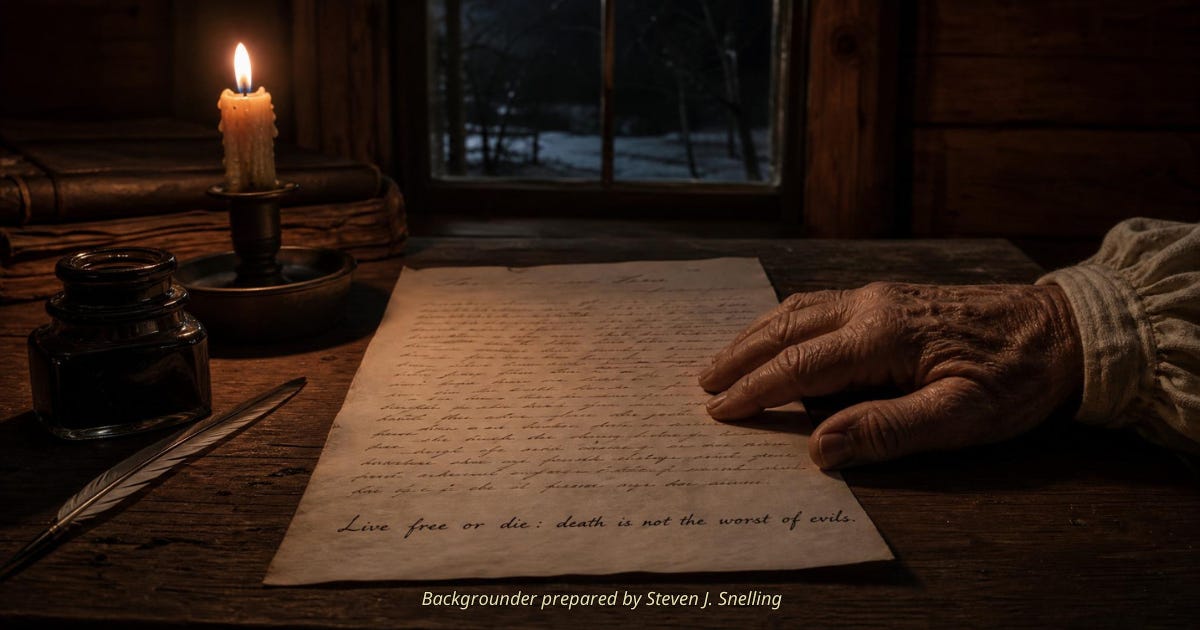
General John Stark wrote those words on July 31, 1809 — not as a battle cry, but as a toast sent by letter from his farm in Manchester, where failing health at eighty-one prevented him from attending a reunion of the men he had led at the Battle of Bennington thirty-two years earlier. The full toast reads: “Live free or die: death is not the worst of evils.” That second sentence has been quietly dropped from the motto’s public life — but it is the sentence that explains what Stark actually meant. He was not being reckless with human life. He was saying that worse things than death exist. Specifically: living without genuine freedom. The veterans who received that letter understood exactly what he meant. They had fought for it.
Stark was writing about human dignity — about the proposition that a life without genuine freedom is not a life worth the name. He was not writing to a tax policy committee. He was not writing to protect investment portfolios or business interests or the financial arrangements of people who find the current system profitable. The people who have recruited his words in service of protecting a regressive property tax system that slowly dispossesses the state’s most vulnerable residents have taken considerable liberties with what he actually said — and they have been careful to use only the part of the toast that serves their purpose, while leaving behind the part that explains it.
In 1977, the United States Supreme Court ruled seven to two in Wooley v. Maynard that the state of New Hampshire could not compel its own citizens to display the motto on their license plates. George Maynard, a Jehovah’s Witness, had covered the words “or Die” on his plate on grounds of conscience — stating that by his religious belief, his highest government was one that offered everlasting life, and that it would be contrary to that belief to pledge his life to the state. The Court agreed with him. Chief Justice Warren Burger wrote that the First Amendment protects not only the right to speak freely but the right to refrain from speaking at all — and that the state cannot force an individual to be an instrument for fostering public adherence to an ideological point of view he finds unacceptable.
The Supreme Court of the United States ruled, in other words, that Live Free or Die does not mean the same thing to everyone — and that New Hampshire cannot require it to.
We raise this not to diminish the motto. We raise it because there are voices in this debate who use it as though it were settled constitutional doctrine that the phrase means: no income tax, forever, regardless of what it costs the people least able to pay. It does not mean that. It has never meant that. The Supreme Court confirmed, nearly fifty years ago, that New Hampshire residents have the constitutional right to interpret their own state motto according to their own conscience and conviction — and that no political interest, however well funded or long established, has the authority to declare the interpretation closed.
Live Free or Die belongs to all of us. Including Margaret. Including the retired mill worker. Including the young family in Claremont doing the math on whether they can stay. It does not belong exclusively to the people whose financial interests are served by ensuring that the conversation about what genuine freedom actually requires never seriously happens.
We believe that. We suspect you do too.
Here is what we also believe.
There is nothing free about receiving a tax bill twice a year for costs you never voted for, transferred onto your property by people in Concord who decided their obligations were better carried by you. There is nothing free about a retired neighbor sitting at her kitchen table in December calculating whether the heating oil goes on the credit card so the tax bill can be paid on time. There is nothing free about a young family doing the math on whether New Hampshire is still a place they can afford to raise children in — and concluding, quietly and without fanfare, that it isn’t. There is nothing free about a system that has been engineered, over fifty years and with considerable money, to look like freedom while functioning as its opposite for the people who can least afford the difference.
What we have now is not the New Hampshire that John Stark was describing. It is a careful simulation of it — maintained by people who have found the motto useful and the reality profitable.
Genuine freedom — the kind worth dying for — requires honest accounting. It requires a system in which the obligations of living together in a civil society are distributed according to what people can actually bear, not according to what is most convenient for the people with the most to protect. It requires that when a government tells its citizens they are free, that freedom means something real in the lives of the people hearing it — not just in the tax returns of the people who engineered the telling.
A constitutional dedication mechanism that replaces the most regressive portion of the property tax burden with a proportional income tax is not an attack on the New Hampshire identity. It is an attempt to make that identity real — for Margaret, for the mill worker’s widow in Berlin, for the young family in Claremont, for everyone on that street who has been paying for a freedom that was always more available to their neighbor than to them.
The ghost of Bill Loeb cannot vote. He cannot campaign. He has been dead for forty-four years. The pledge he extracted from generations of New Hampshire politicians was made in service of a newspaper publisher’s convictions and a certain class of people’s financial interests — and it has been honored faithfully, at extraordinary cost, by the people who could afford it least.
It is time to honor something else instead.
It is time to honor the retired teacher’s aide who paid off her house over thirty years and deserves to stay in it. The mill worker who spent forty years contributing to this state and deserves a retirement that isn’t a monthly calculation of what goes unpaid. The young family that wants to build something here and deserves a tax system that doesn’t make that choice impossible before it begins.
It is time, in the plainest sense of the words, to Live Free.
Actually free.
Not free as a slogan. Not free as a campaign pledge. Not free as a carefully maintained illusion that serves some of us while slowly impoverishing the rest.
Free as something real. Something honest. Something that means the same thing in Margaret’s kitchen in December that it means in the statehouse in Concord.
That is the New Hampshire worth fighting for.
And it is still possible.
This backgrounder is part of The Quiet Cost series, examining policy patterns in New Hampshire’s current and recent legislative sessions. Prior backgrounders are available at The Quiet Cost. If this piece reached you through a friend or a share, we are glad it did. The pattern only becomes visible when enough people are looking at it at the same time.
Now you know.
Didn’t have time for the full piece? Start here.
Plain Language Summary — For Busy Readers
This backgrounder makes one central argument, supported by documented facts:
New Hampshire does not have a low-tax system. It has a hidden tax system — and it has been deliberately designed to look like something it isn’t.
Here is what the evidence shows:
New Hampshire has the fourth highest effective property tax rate in the nation.
The bottom fifth of earners pay nearly nine percent of their income in state and local taxes. The wealthiest one percent pay roughly two and a half percent.
A significant portion of what appears on your local property tax bill represents state obligations — retirement system contributions, education mandates, county costs — transferred downward onto local taxpayers without their vote.
The assessed value your property tax bill is calculated from is not a verified fact. It is a professional estimate, acknowledged as such by the state itself, which applies a correction ratio on top of local assessments to compensate for the imprecision.
An income tax — if constitutionally dedicated exclusively to property tax relief, with independent annual auditing and an automatic repeal trigger if property taxes don’t decrease — would not be a new burden. It would be a fairer way of collecting what is already being taken, from everyone, in proportion to what they can actually afford.
Here is what that would mean in practice:
A retired neighbor on $22,000 a year and a remote worker earning $185,000 currently pay identical property tax bills. As a share of income, the retiree pays nine times more.
Under a constitutionally dedicated income tax replacing the downshifted portion of the bill, both pay less in property tax. The retiree pays no income tax. The professional contributes proportionally — and pays less in total than he does today.
The total public obligation doesn’t change. Who carries it, and how fairly, does.
Here is what this backgrounder is not saying:
It is not saying trust the legislature to do the right thing. It is saying build a constitutional amendment that removes that requirement entirely.
It is not saying Live Free or Die means nothing. It is saying the motto has never meant one specific tax policy — the Supreme Court confirmed that in 1977 — and that genuine freedom requires honest accounting.
It is not saying the current system is anyone’s fault for supporting it. It is saying considerable money was spent over fifty years specifically to make sure most people never examined it closely enough to see what it was costing them.
The full backgrounder is above. It is long. It earns every word.
But if this summary is as far as you got today — now you know.
Sources: NH Department of Revenue Administration municipal tax rate data; Institute on Taxation and Economic Policy NH tax burden by income data; NH General Court legislative records; Wooley v. Maynard, 430 U.S. 705 (1977); John Stark letter of July 31, 1809, as reproduced in Caleb Stark, Memoir and Official Correspondence of Gen. John Stark (1860); NH Retirement System contribution rate history; NH Bulletin, Concord Monitor, InDepthNH, Valley News reporting; Senator Perkins Kwoka public statements; Prior backgrounders in The Quiet Cost series.
About sources and drafting methods →
Fantastic series, written with exquisite attention to detail and great clarity. Is there a way to distill the essence to a much shorter form without losing too much of the strength of argument? I fear there will be many who, even if exposed to the article(s), will not persevere beyond the first section or two. The modern mind favors brevity for the most part, as with The Pledge for instance.
I am loving your work and appreciate the clarity of your writing. I hope we can move NH forward. I am more than ready.